Handheld GPS: The Smart Tool for Your Grand Adventures

Garmin:Handlebars.jpg

With the rise of ultra-running and riding, we find ourselves further and further off the grid. Quite often we also find ourselves lost. I’ve always been partial to “lost,” it’s the place where I’ve discovered the most amazing delights. But, when I’m at mile 87 of a 100-mile gravel/off-road/back-country event, being lost loses much of its charm. Fortunately, we live in the information age. Except for the most entrenched Luddite we all have a smart phone, which can usually get us un-lost. But there are times when a smart phone is no match for the vagaries of mother nature. Happily in those times technology 2.0 comes to the rescue. Today’s handheld GPS units are smaller than a bar of soap, incredibly accurate, and impervious to inclement weather. These days, you can get yourself completely lost and still be home for dinner.

You might be wondering why you need a handheld GPS unit in addition to your smart phone. Smart phones are great for getting around town and avoiding traffic in the comfort of your car, (with the phone safely plugged into your car charger) but the GPS function is an energy hog and will drain your battery rapidly. Smart phones also tend to be a very fragile, impossible to access while wearing gloves, sensitive to rain, mud, direct sunlight, and screen-destroying falls from not-so-high places. With a price tag of up to $999.99, smart phones are a less-than-ideal choice for rugged off-road adventures. Another downside of the smart phone is the restrictive data plans of most cell phone providers. This is especially challenging if your grand adventure takes you to exotic locales halfway around the world. A dedicated GPS unit is a far superior choice for off-the-grid adventures.

GarminEtrex22x.png

It will come as no surprise that two of the most highly recommended units are made by Garmin. The eTrex 22X ($169.99 msrp) and the eTrex 32X ($269.99 msrp) are both excellent and affordable options. These units communicate with standard US-based GPS and with GLONASS, a global satellite network.  Working in tandem, these two positioning systems can find you in all but the densest of forests and deepest of valleys. At approximately 2” x 4” x 1.3” and less than five ounces, these palm-sized units are packed with features, yet still slide into a small backpack strap pocket.  Garmin’s eTrex models also have a 2.2” (diagonal) transflective screen with 65K color TFT, meaning the display is readable in direct sunlight. They come pre-loaded with TopoActive maps, and Garmin has a complete library of downloadable, worldwide topographical maps. The device has memory for up to 2,000 waypoints and 200 routes. It can also be set for automatic routing when on the road. Both eTrex models come complete with a USB cable, 8GB of memory, and a slot for a microSD card (card sold separately) to save all your critical data on the go. The units are incredibly durable and have a waterproof rating of IPX7. While not suitable for swimming, snorkeling, scuba diving, or high-speed watersports, they will certainly survive a rainstorm, snowstorm, or quick dip in the toilet bowl. Most importantly, these units run on ubiquitous AA batteries (any old AA will do, but they recommend NiMH or Lithium batteries for longer run time), which can be purchased at most mom and pop convenience stores worldwide. Those two batteries will give you up to 25 hours of use in GPS mode. A few sweet bonus features are hunting and fishing calendars, sun and moon information, and a picture viewer. For those of you who like a good treasure hunt, these units are Geo-Caching friendly. Finally, if you really like to geek out on satellite imagery, you can subscribe to Birdseye Satellite Imagery, which allows you to download and integrate satellite imagery with your maps. 

The more expensive Garmin eTrex 32X has three valuable additions: a barometric altimeter that tracks cumulative elevation, an old school 3-axis magnetic compass that will show you your direction even if you aren’t in motion (unlike regular GPS), and wireless connectivity with ANT+. 

While a handheld GPS device might seem like a godsend, it is no substitute for old-fashioned paper maps, a magnetic compass, a basic tool kit and first aid kit, some mountaineering skills, and a good dose of common sense. Accidents happen, batteries die, things plunge to the bottom of outhouse toilets, and digital maps aren’t always accurate. A good scout is always prepared.

 In today’s hyper-connected world sometimes we need to unplug and walk (or ride) away. A handheld GPS can guide you to a vast array of hidden pleasures, far from everyday troubles, to a place where you can be present with your thoughts and with the delights of mother nature. Use your handheld GPS to find that perfect secluded spot for a snack, a skinny dip, and a siesta, before making the long trek back to the demands and chaos of the modern world.

For complete product information, check out Garmin eTrex 22X or Garmin eTrex 32X.

Fixed Gear Bikes: Not Just for Poseurs

Winter time is the perfect time to become a one-gear convert.

Winter time is the perfect time to become a one-gear convert.

It was a cold and foggy Wednesday in January. The steam was rising from our bodies as we pushed over the final climb from Mill Valley to Four Corners. Awaiting our arrival was a parade of cyclists lit up like Christmas trees. They wore white hot headlamps, blinking red taillights, helmet lights front and rear, jackets and vests with a dizzying array of reflective tape, and spinning spoke lights in every color of the rainbow.  Safety had risen to an entirely new level on those chilly, after-dark workouts. The anticipation was mounting as we awaited the arrival of our coach. We all knew that he was going to put the hurt on us, and this was destined to be a particularly painful night.

 “How many laps do you have to do tonight?”

 “Only three.  How about you?”

 “Coach thinks I’m ready for four.”

“Ouch. Good luck with that, Sheila.”

The night was magical, the moon full and bright. The fog rolled across the ridge but the valley was clear and still. One by one we doused our lights as we approached each lap of the climb, riding by the light of the moon, serenaded by a symphony of frogs and crickets.  The first three ascents had been nearly effortless, one of those perfect workouts. Then I reached a 12% grade followed by a 16% hairpin, about halfway up my fourth and final lap.  It was then that the grunting and whimpering began. I was out of my saddle, trying to use every ounce of my body weight to get those dang cranks turned over. “I…just…can’t…do…it,” I whined.

 “Everyone – off your bike!” my coach bellowed.

Together, we walked the steepest portion of the climb, remounting just before the last hairpin to ride the final stretch.  Everyone let me lead the pack over the final pitch of what would be my first, and last, four-lap night. It was my victory lap, bittersweet for the section walked, but a victory nonetheless.

Our winter training regimen included a weekly nighttime fixed-gear group ride that descended Highway One west of Mill Valley, passed the Pelican Inn and the turn off to Muir Beach, before turning onto the twisty-turny false flat uphill Muir Woods road, culminating in the 1.6 mile climb back to Four Corners -- a climb with an 8-10% average grade, and occasional pitches of up to 15%. After that winter’s regimen, I was finally able to pedal in circles rather than squares; I could climb almost any hill, with ease, in the comfort of my saddle; and my normal cadence approached 100 rpms. Best of all, my mashing-induced knee pain had vanished.

I’ve heard many people dismiss fixed gear bicycles on the road as something for bike messengers, bike polo aficionados, and hipster poseurs.  In truth, a fixed gear bike equipped with front and rear brakes is an incredible training tool. The beauty of a fixed gear lies in its simplicity. Relieved of the need to shift, you can focus your attention on a smooth pedal stroke, something a fixed gear forces you to do unless you like bouncing on your saddle, bumping your private parts with every stroke. The bikes are stealth machines, silent, devoid of the click, shift, and whir of derailleurs. Equipped with a beefy BMX chain, they are nearly maintenance free, especially on dirty wet pavement, free of cogs and pulleys, cables and fragile chains. This is one bike you can comfortable hose down, dry and lube the chain, and it is ready for another beating. And counterintuitive-but-true, but climbing on a fixed gear is often easier and faster than a geared bike.  You don’t have the option of easier and easier gears, the powerful up-stroke kick propels each leg up and over, and on a steep climb you have to keep your momentum or you might be standing stock-still in the middle of the climb, just before you tip over and are lying in the middle of the road still clipped in. The most important thing to remember about fixed gears is that you cannot coast. My first outing I forgot this cardinal rule and attempted to coast the first descent.  Of course, my bronco nearly bucked me and, “don’t coast, don’t coast, don’t coast” became my new fixed gear mantra.

 The Equipment

You’ll need a fixed gear bike with front and rear brakes and a gear ratio around 67.5 gear inches. This equals a 42 X 16 or 42 X 17. The brakes and the gear are critical for a couple reasons.  The goal is not to blow your knees out by pushing too hard of a gear or by using your legs to stop your machine.  You want to use your brakes to keep your cadence at a manageable speed and to stop you in case of emergency.  For climbing, you want a gear that you can turn over and get yourself up the hill. 

These days it’s surprisingly easy to convert an old road bike into a new fixed gear.  There are many websites that tell you how to do this. Sheldon Brown is one of the old-school gurus, and a trusted source of information for all things bike. You can check him out here. If you have the mechanical skills and patience, you can do it yourself. If you are like me, your local mechanic can help set up your new toy. I was fortunate to have a few bike geek friends; one found me a classic old Fuji Roubaix that had vertical dropouts, another gave me his gently used flip-flop rear wheel (fixed on one side and freewheel on the other, but I love the fixed side so much that I have never flipped it), a third friend put it all together for me.  The entire bike cost me less than $200.00, but if you are jonesing for the beautiful new Blue Chinook, this might be just the excuse you need to transform your current road bike into a fixie and put your down payment on a new steed!

If you plan to attempt this feat at night, I strongly recommend a good headlamp, taillights, reflective clothing, and any other light that will enhance your visibility.

The Terrain

Pick a 10-12 mile loop or out-and-back with a 1.5-2 mile climb averaging 8-10% and a flat recovery section between the descent and the ascent.

The Exercise

Descent: The goal is to pedal as quickly and smoothly as possible.  When you first attempt fixed gear descending you will find yourself bouncing uncontrollably in the saddle. The key is to use your brakes to slow the bike enough that your cadence can keep up with the rear wheel revolutions. Over time, you will find your legs spinning faster and faster while your butt remains firmly planted on the saddle.

Flats: This is your opportunity to recover, which you’ll need because fixed gear descending is deceptively challenging, much more difficult than coasting. The flat recovery section also gives your body the chance to commit the increased leg speed to muscle memory.

Ascent: you can think of this portion as a (seemingly) never-ending series of single leg squats or leg presses. Most of the climbing will be seated, unless the grade becomes too steep or you are so worked that you need the weight of your entire body to turn over the cranks. You want to rely on your core to quiet the motion of your body and focus all your energy on your legs, smoothly turning over the cranks, focusing as much energy on the down-stroke as on the up-stroke.

 Duration

You should plan on 1.5-2 hours, plus warm-up and cool-down. Challenge yourself to complete one additional ascent each month.

Don’t be surprised if your fixed gear bike becomes your go-to off-season bike. In addition to being an amazing training tool and a low-maintenance inclement weather bike, fixed gear riding is surprisingly, counterintuitively, exhilarating fun. And when you do get back on your Blue Chinook (or other race bike), you’ll be surprised at how you can fly.


Fueling for the Long Haul

IMG_9263.jpg

Sweet Potato & Kale Stovetop Frittata: Your Breakfast Sonata

Before a big training day I happily set my alarm 30 minutes early so I can cook up my favorite breakfast: Sweet Potato & Kale Stovetop Frittata. This masterpiece of a meal is loaded with calories, protein, beneficial fat, simple carbohydrates for a quick energy boost, complex carbohydrates to keep you rolling for hours, and lots of vitamins and nutrients to keep your body running like the finely tuned machine it is. 

 Ingredient 411

Eggs and nutrition scientists have had a volatile relationship. In the beginning, eggs were the perfect food. Next, they were deemed perfectly evil. Now that the connection between dietary cholesterol and cholesterol in the blood is better understood eggs are a perfect food once again -- in moderation, of course. Eggs are low in calories, high in quality protein including all the essential amino acids, and loaded with HDL cholesterol, the good cholesterol. In fact, eggs actually help increase your good cholesterol (HDL) and decrease your bad cholesterol (LDL). Besides vitamins A and D, eggs also contain the nutrients choline, leutein, and zeaxanthin, which help rebuild cell membranes and maintain eye health. In essence, eggs are a shell-contained, nutrient rich, protein bomb.

Fat is your friend. It is a refrain we often hear, but did you ever stop to discover why? Olive oil, canola oil, soybean oil, and nuts are rich in polyunsaturated fats and monounsaturated fats. Research has shown that polyunsaturated fats reduce the risk of heart disease and prevent insulin resistance. They are great sources of antioxidant vitamins A and K. They are rich in omega 3 and omega 6 fatty acids, which are essential for building healthy cells and maintaining brain and nerve function. Additionally, they are high in calories, a benefit for endurance athletes who burn a tremendous amount of calories during, and after, workouts. Studies show that eating moderate amounts of these good fats can actually lead to weight loss. 

For years I considered onions, garlic, and all those tasty yet pungent members of the allium family a delicious and aromatic base to every savory dish I cook. As it turns out, onions and their kin are loaded with healthful benefits. Rich in vitamin C, vitamin B, and potassium, onions are amazing antioxidants. Oxidation, a chemical reaction in our body that can produce free radicals, is a normal occurrence. Free radicals are known to damage our cells. Eating a diet high in antioxidants can actually terminate these chain reactions. They also help fight inflammation, reduce cholesterol, and vitamin C helps the body access and absorb iron. Onions even have antibacterial properties that can help your body fight e-coli and other nasty beasties. Most importantly, there is nothing quite as homey as the scent of sautéed onions.

Everyone knows that kale is good for you, but few people know just how delicious kale can be. It’s worth learning to prepare kale, because just one cup of raw kale contains 684% of our RDA of vitamin K (in addition to being an antioxidant, vitamin K aids in blood clotting, highly valuable to those of us who are frequently on kissing terms with the pavement), 206% of our RDA of vitamin A, and 134% of our RDA of vitamin C, yet another great antioxidant. Kale also contains three grams of almost perfect protein, meaning it contains the nearly full complement of amino acids. It is also a great source of the minerals magnesium, potassium, and calcium. Surprisingly, kale is a better source of calcium than dairy products. Finally, kale has a high water content, which helps you feel full and in turn aids weight loss.

Recently, I elevated sweet potatoes to my personal pantheon of super-foods. Not only are they easy to cook, they taste great and are packed with nutrients and energy-producing complex carbohydrates.  The Glycemic Index (GI) of sweet potatoes is 48, much lower than white rice (72), new potatoes (70), whole grain bread (72), a banana (62), or a can of Coca-Cola (63). Lower GI sweet potatoes will release glucose more slowly, increasing glucose availability later in the exercise period. In addition to the lower GI, one cup of sweet potatoes is loaded with vitamin A (769% of RDA) and vitamin C (65% of RDA). As we’ve already seen, these vitamins are antioxidant powerhouses. A high fiber food, sweet potatoes are great for gut health. They keep things moving through your intestinal track, fuel healthy gut bacteria, inhibit bad bacteria, stimulate blood flow to the colon, decrease inflammation, and increase mineral and nutrient absorption. While both regular and sweet potatoes are highly nutritious, regular white potatoes are a member of the nightshade family (tomatoes, eggplants, bell peppers, cayenne, and paprika).  Some people have dietary sensitivities to the nightshades, so sweet potatoes are a great alternative.

One or twice a week I bake a mess of sweet potatoes -- just wash them and throw them in a 350 degree oven, skin and all, for about 45 minutes or until they are tender when pricked with a fork. They can then be stored in the refrigerator for a week or more. When I’m feeling peckish, I always have a healthy snack on hand. I’ve also been known to head out on a long run or ride with a spud or two tucked into my back pocket. Sweet potatoes are a great alternative to the overly processed, sugar-laden, “energy” foods that we usually consume on our endurance outings.

Sweet Potato & Kale Stovetop Frittata
Servings: 1 - 2

Ingredients*

 1 tablespoon olive oil
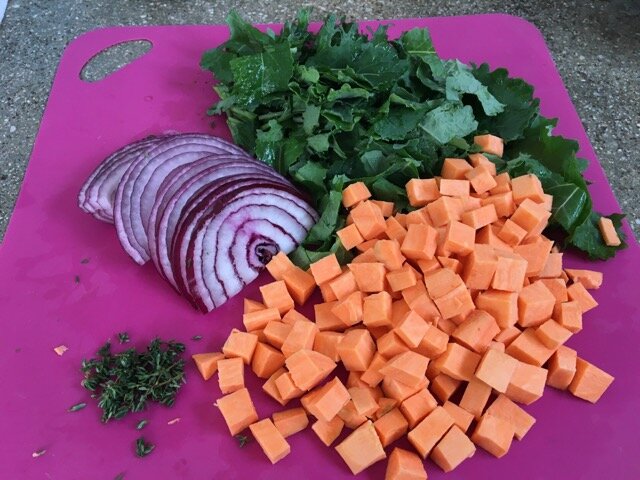
½ medium onion - peeled, halved, thinly sliced
1 large pinch of salt
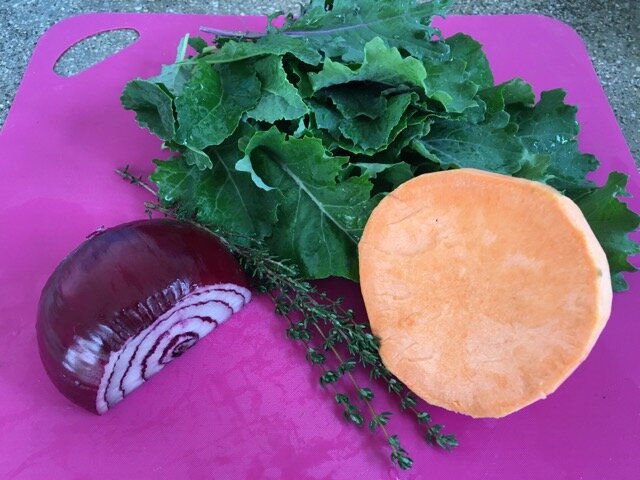
1 cup sweet potato – (raw or pre-cooked) peeled and cut into ½” squares
2 cups kale – washed and cut into ½” slices
1 tablespoon fresh thyme
2 eggs
¼ cup full fat yogurt or sour cream
1 tablespoon ground chipotle chiles en adobo (optional)
Ground black pepper
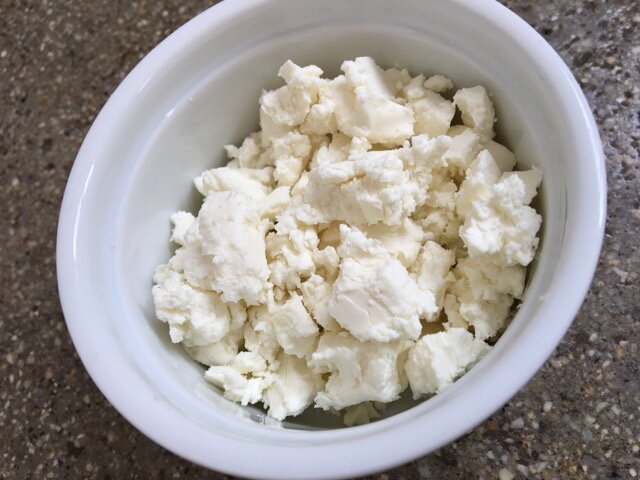
¼ cup goat cheese

*Quantities are mere suggestions. Frequently, I will use just one egg, double the vegetables, and omit the cheese. You might choose to add an egg and double the cheese to up the calories and the protein content.

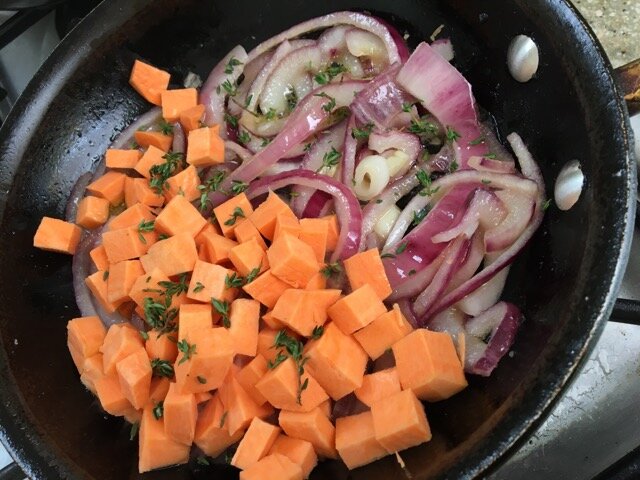
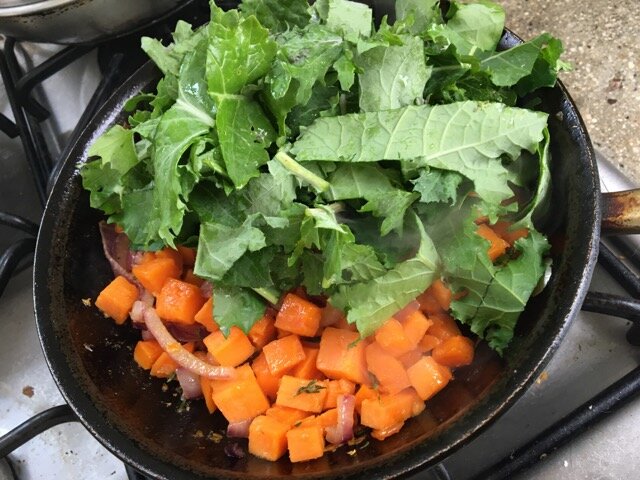
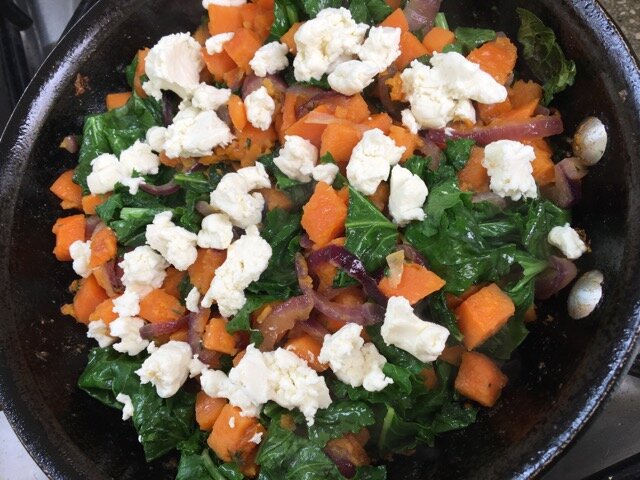
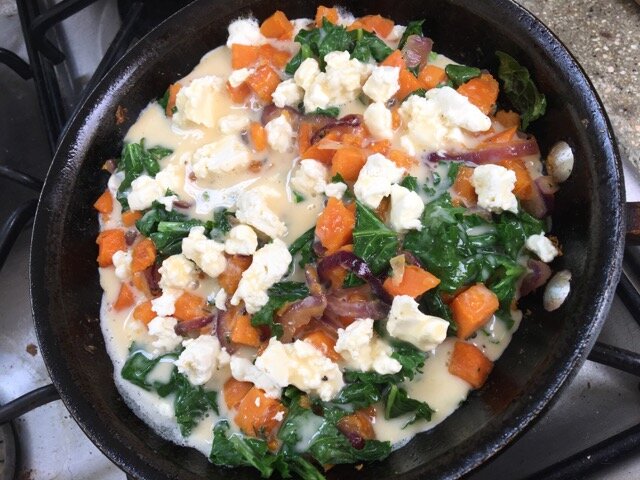
Heat oil over medium heat in an 8” non-stick frying pan with a lid (matching or otherwise). Add onion and salt. Stirring frequently, sautée until just translucent and soft.  Lower heat slightly and add sweet potatoes. If the pan is dry, you might need to add more olive oil.  Cook, stirring frequently, until potatoes are tender. Stir in kale and thyme and cover until kale is slightly wilted.  

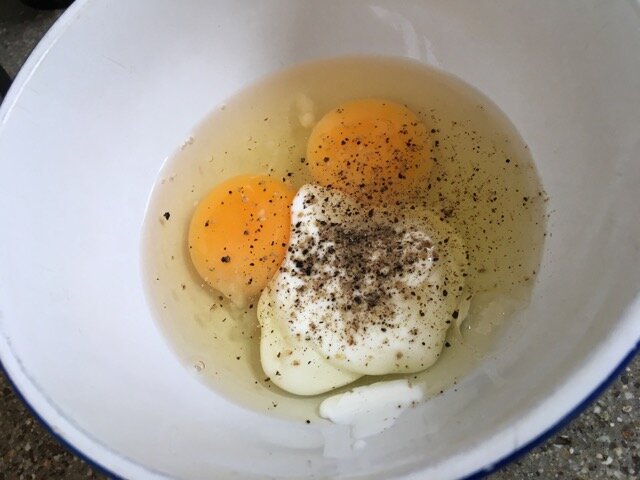
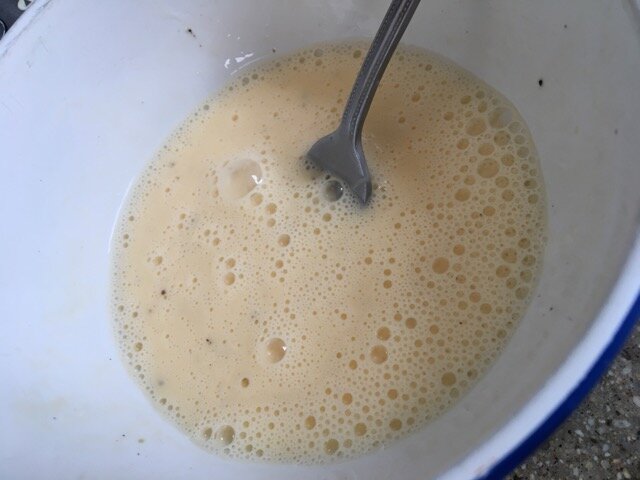
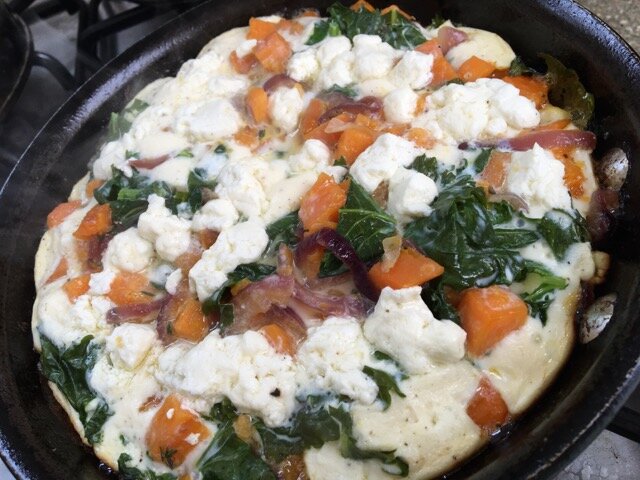
While the potatoes are cooking, mix eggs, yogurt, (optional chipotle chiles) and black pepper with a fork until they are completely blended. Turn the heat to the lowest level, pour the egg mixture over the vegetables, crumble cheese on top, cover, and cook until the eggs are completely cooked. The frittata will puff up, soufflé style. This should take less than 10 minutes.

Frequently, I will double the recipe so I have a tasty treat awaiting my return.  I might even put the leftovers in a sandwich baggie and eat it during my long workout.

This recipe is incredibly versatile.  The choice of vegetable, herb, and cheese are completely optional.  Some of my other favorites are: asparagus and mushroom with lemon zest, thyme, and Parmesan; bell pepper and cauliflower with sage and Gruyere; cabbage and eggplant with oregano and mozzarella; or new potato and spinach with rosemary and sharp cheddar. All of these are cooked in the same manner. The only difference is the cooking time, since starchy vegetables such as potatoes and carrots tend to take a bit longer.  In addition to being nutritious and filling, the variations are only limited by your imagination.

Your mama always told you, “Breakfast is the most important meal of the day,” and this is especially true for endurance athletes. A bowl of cereal with milk, orange juice, and a cup of coffee adds up to 359 calories. That is simply not sufficient to fuel your training – even a moderately paced three-hour road ride can burn 2500 calories or more. The power and nutrient packed ingredients in the Stovetop Frittata will set you up for a long training day, and provide the anti-oxidants to aid your recovery.

 Buen Provecho!

Dirty Kanza 200 success on the new BLUE Hogback

BLUE’s own Dean Myers took on the Dirty Kanza 200 and successfully finished the 202 mile relentlessly rough, tough, and dirty course with 10,000 feet of climbing on his Hogback gravel bike. Here he is at mile 180 taking a short rest on the infamous “Chase the Chaise” couch. Equipped with Shimano Di2, Stages Ultegra Power Meter Crankset and Aerus Carbon 35GR wheels the bike withstood the beating with no mechanical issues. He road on tubeless 700x38mm tires without a flat but a majority of people had at least one. A tidbit of advice he gave us after his first try at this event is “make sure you eat all you can in hours 2 through 6 as so many people didn’t finish because of nutrition and they hit the wall half-way through and can’t recover. I almost didn’t get back on my bike at mile 121 with leg cramps and total fatigue but got a boost from the aid station volunteers and my “all-in” playlist to get back on and kept going. It is so hard to make yourself eat when it’s hot, the road is so rough, and your stomach doesn’t want to process anything but you gotta shove it down anyway”. BLUE had a great time exhibiting at the event and plan to come out and participate even bigger in 2020.

Top American Pro Triathlete Alicia Kaye signs with BLUE Competition Cycles

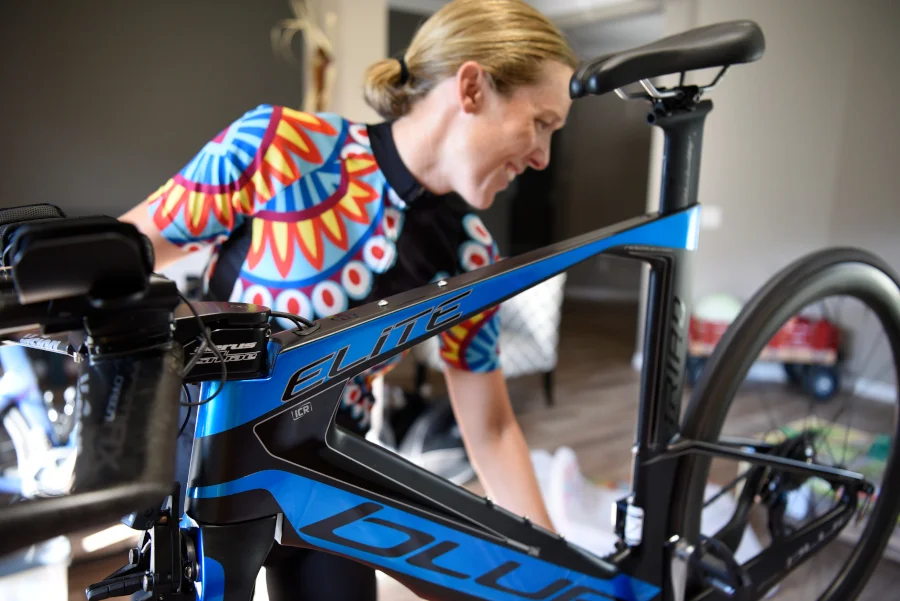
Blue welcome top American professional and 5-time Ironman 70.3 Champion Alicia Kaye to the team. Alicia is one of the fastest women cyclists in the sport having logged multiple sub 60-minute 40 km bike splits throughout her career. She looks forward to more bike course records in 2019 on board the BLUE Triad Elite superbike). Kaye’s husband, US Olympian Jarrod Shoemaker also rides BLUE and we are thrilled to have the entire household on board our bikes in 2019. Welcome Alicia.

Check out Alicia getting setup on her new Triad Elite.

How to Stay Motivated in the Winter by Brittany Warly - Pro Triathlete

LARR9448.jpg

I get asked the question "how do you stay motivated in the winter?" quite often really. I am human, like everyone else, and the cold, dark mornings make it that much more difficult to get out of my warm bed in the morning. I have a number of tricks/ideas that I use in the winter months especially to stay motivated and maintain consistency in my daily training.

20181223_093155.jpg
 
embrace the trainer. It'll make riding on the road that much easier!

embrace the trainer. It'll make riding on the road that much easier!

1. Find yourself some training partners.
Having training partners is a great way not only to hold yourself accountable, but also to keep the sport fun and fresh. A training camp can also be a great way to change your perspective and environment, while motivating you to work hard on the daily. Surround yourself with like-minded people and it's amazing what you can do together.

2. Plan out your season goals.
Before the next season begins, I like to write out specific outcome-based goals, and then process-related goals of how I will get there. I also like to plan my early season races, which gives me incentive to build fitness in the off-season. A goal on the horizon, can make a significant difference when it comes to finding motivation to train.

3. Music.
Music has been a great friend of mine in the winter, especially to keep me motivated and entertained while on the trainer with my Blue AC1 Limited Road Bike or running on the dreadmill (yes I spelled that correctly). I also like to have different genres of music based on the purpose of each workout. Even when the body doesn't feel great, music has a way of inspiring.

4. Go outside
Even when it is cold outside, sometimes it can be beneficial and give you a fresh perspective to bundle up and run outside. Think of the snow on the ground as a change of scenery and fresh perspective on your typical running routes. Every Wednesday, I run a 6 am sunrise run with my roommate, Caryn. We both bundle up and hit the roads with our headlamps. It's a nice morning adventure that motivates me to wake up early :)

5. Yoga.
Practicing mindfulness in the form of yoga or meditation can be very helpful in defining your purpose, letting go of your past, and channeling your energy to future goals. Given I have a body-type that struggles in the cold, the heated sessions especially are beneficial to my overall recovery and ability to relax.

6. Get in the gym and hit it hard!
In the summer season, it's typically race season so gym training is usually a supplement to training and not the core part of training/racing. In the winter time, change it up by hitting the gym hard three times per week. Gym has become one of my workouts in the winter. Building strength will translate to a stronger, healthier body when the season comes around.

FB_IMG_1544570765993.jpg

Original Posting: https://brittanywarly.blogspot.com/2019/01/how-to-stay-motivated-in-winter.html

New Pro Triathlete Brittany Warly Sponsorship Announced

Brittany Warly is a budding pro triathlete focusing on the ITU and World Cup Sprint triathlon series. Located in Colorado Springs just an hour or so from Blue’s headquarters we are happy to partner with her and help Brittany go as fast a possible on the bike leg of her events with a new BLUE all carbon, Dura-Ace Di2 racing bike.